Lenses
We've conducted the written post-test of 5 items and are analysing the results. A perception survey of the attitudes of the students towards the two learning methods has been conducted in the computer lab using the online assessment feature in our Learning Management System (LMS).
Tuesday, January 30, 2007

Tuesday, January 23, 2007
7 Jan 2007
We've designed an action research project to help us to familiarise with the AR process.
1. A group of students would learn the topic "lenses" (under Light) using an interactive IT-based lesson module (downloaded from MOE http://www.moe.gov.sg/edsoftware/ir/physics.htm and installed in computer lab) while another equivalent group would have normal classroom lessons. Written worksheets were given to both groups for ray-diagram practice.
2. A post-test of 5 items (mcq with reasoning required) would be conducted after the lessons to evaluate the learning effect.
3. A perception survey would also be conducted to find out the attitudes of the students towards the two learning methods.
We've designed an action research project to help us to familiarise with the AR process.
1. A group of students would learn the topic "lenses" (under Light) using an interactive IT-based lesson module (downloaded from MOE http://www.moe.gov.sg/edsoftware/ir/physics.htm and installed in computer lab) while another equivalent group would have normal classroom lessons. Written worksheets were given to both groups for ray-diagram practice.
2. A post-test of 5 items (mcq with reasoning required) would be conducted after the lessons to evaluate the learning effect.
3. A perception survey would also be conducted to find out the attitudes of the students towards the two learning methods.
Monday, December 18, 2006
 18 Dec 2007
I have placed orders for the software Crocodile Physics ver 605. This new version has easy-to-use interactive features to allow easy creation of physics simulations for topics such as kinematics, dynamics, energy, waves, electrical circuits, practical electricity, light, etc. (only limited by our imagination). See screen shot (click to see larger view).
Friday, November 24, 2006
23 Nov 2006
I was surfing the net for educational and research resources. Some interesting finds:
1. The Electronic Journal of Science Education
- an online journal on science education
http://unr.edu/homepage/jcannon/ejse/ejse.html
- or do a journal search using google search engine directly!
http://unr.edu/homepage/jcannon/ejse/ejsesearch.html
2. Physicweb site
- Dr Yap told me about the usefulness of this site to keep up with latest physics and technology developments in the world. Sign up to read full articles for free.
http://physicsweb.org/
I've also inserted an RSS news feed of the physicsworld news to my physics blogsite for my students.
I was surfing the net for educational and research resources. Some interesting finds:
1. The Electronic Journal of Science Education
- an online journal on science education
http://unr.edu/homepage/jcannon/ejse/ejse.html
- or do a journal search using google search engine directly!
http://unr.edu/homepage/jcannon/ejse/ejsesearch.html
2. Physicweb site
- Dr Yap told me about the usefulness of this site to keep up with latest physics and technology developments in the world. Sign up to read full articles for free.
http://physicsweb.org/
I've also inserted an RSS news feed of the physicsworld news to my physics blogsite for my students.
23 Nov 2006
I am attending the 3-day International Science Edcuation Conference organised by NIE, MOE and STAS. Its a good opportunity to meet up with old friends, ex-colleagues, working in schools or at MOE HQs. Its also a good time to reflect on my teaching practices as I listened to speaker after speaker on what they have tried out as science that works!
Find out some of the keynote speakers at
http://www.nsse.nie.edu.sg/isec2006/
I am attending the 3-day International Science Edcuation Conference organised by NIE, MOE and STAS. Its a good opportunity to meet up with old friends, ex-colleagues, working in schools or at MOE HQs. Its also a good time to reflect on my teaching practices as I listened to speaker after speaker on what they have tried out as science that works!
Find out some of the keynote speakers at
http://www.nsse.nie.edu.sg/isec2006/
Saturday, November 18, 2006
17 Nov 2006
Wan Eng joined us for the Sharing/Discussion at Crescent Girls' School.
Some of my learning points today:
1. experimental induction of formula
2. instructional strategies for Electricity
3. Action Research - what is and what is not
4. findings and methodolgy of action research (MGS)
5. ideas for IT-enhanced inquiry-based approach
Wan Eng joined us for the Sharing/Discussion at Crescent Girls' School.
Some of my learning points today:
1. experimental induction of formula
2. instructional strategies for Electricity
3. Action Research - what is and what is not
4. findings and methodolgy of action research (MGS)
5. ideas for IT-enhanced inquiry-based approach
16 Nov 2006
Mr Lau, Wee Yap and I attended the Sharing/Discussion on Action Research in PbI (Electricity) organised by CPDD at Crescent Girls' School.
Some of my learning points:
1. principles of learning - pre-existing knowledge, develop competence in learning, and active learning
2. essential features of inquiry-based lessons
3. ideas first -> names later -> formulae last
3. common preconceptions and difficulties in the topic Electricity
4. use of student worksheets and activities (used by Crescent Girls'): varied, engaging, hands-on, language use ("wordiness"), time management, use of teaching moments
5. model building using what students can understand/relate to, before introducing new terminology
Mr Lau, Wee Yap and I attended the Sharing/Discussion on Action Research in PbI (Electricity) organised by CPDD at Crescent Girls' School.
Some of my learning points:
1. principles of learning - pre-existing knowledge, develop competence in learning, and active learning
2. essential features of inquiry-based lessons
3. ideas first -> names later -> formulae last
3. common preconceptions and difficulties in the topic Electricity
4. use of student worksheets and activities (used by Crescent Girls'): varied, engaging, hands-on, language use ("wordiness"), time management, use of teaching moments
5. model building using what students can understand/relate to, before introducing new terminology
15 Nov 2006
The project team (Mr Lau, Wan Eng, Peici, Wee Yap and I) met to review the 2006 LEAD IT@Deyi work plan and discuss the 2007 work plan. Chip Pin has a CCA commitment. Wee Yap just joined our physics team after completing his NIE training. Key areas of discussion include topics for and schedule of inquiry-based lessons for 2007, consultancy and partnership, training and professional sharing, and lesson IT resources.
The project team (Mr Lau, Wan Eng, Peici, Wee Yap and I) met to review the 2006 LEAD IT@Deyi work plan and discuss the 2007 work plan. Chip Pin has a CCA commitment. Wee Yap just joined our physics team after completing his NIE training. Key areas of discussion include topics for and schedule of inquiry-based lessons for 2007, consultancy and partnership, training and professional sharing, and lesson IT resources.
Friday, November 10, 2006
10 Nov 2006
My school staff just visited Nanyang Poly today. Its facilities, course offerings, and teaching and learning environment are impressive. Would consider some form of collaboration (Learning@NYP) for our students to have exposure and access to applied-physics courses and facilities. Inquiry learning could be weaved into the lesson design.
My school staff just visited Nanyang Poly today. Its facilities, course offerings, and teaching and learning environment are impressive. Would consider some form of collaboration (Learning@NYP) for our students to have exposure and access to applied-physics courses and facilities. Inquiry learning could be weaved into the lesson design.
Saturday, October 28, 2006
26 Oct 2006
I met up with an NIE lecturer and Alexis (ETD) to discuss areas of collaboration. Some useful ideas thrown up:
1. There are different "models" of inquiry with different dimensions for investigation. These may be modified or adapted to the needs of the project or the intervention strategy identified.
2. An inquiry-based approach seeks to engage learners in different orders of thinking.
3. Such an approach may be based on ICT via an online module.
4. A two-tiered mcq requires an initial large population exploratory survey to gather possible trains of thought which follows from each of the first-tier option given.
5. If the project design is valid and substantial data is available, a good analysis of the data can lead to a good research paper.
I met up with an NIE lecturer and Alexis (ETD) to discuss areas of collaboration. Some useful ideas thrown up:
1. There are different "models" of inquiry with different dimensions for investigation. These may be modified or adapted to the needs of the project or the intervention strategy identified.
2. An inquiry-based approach seeks to engage learners in different orders of thinking.
3. Such an approach may be based on ICT via an online module.
4. A two-tiered mcq requires an initial large population exploratory survey to gather possible trains of thought which follows from each of the first-tier option given.
5. If the project design is valid and substantial data is available, a good analysis of the data can lead to a good research paper.
Wednesday, October 25, 2006
25 Oct 2006
CPDD (MOE) is organising a discussion cum hands-on session over two days 16 and 17 Nov on implementing an action-research project in the topic "Electricity" at theTeachers Network. Some of our physics teachers will be attending. We hope to gain some useful ideas on implementing action research in "Electricity" next year and to adapt the PbI material developed by Prof. L.C. McDermott and the Physics Education Group from the Universityof Washington.
CPDD (MOE) is organising a discussion cum hands-on session over two days 16 and 17 Nov on implementing an action-research project in the topic "Electricity" at theTeachers Network. Some of our physics teachers will be attending. We hope to gain some useful ideas on implementing action research in "Electricity" next year and to adapt the PbI material developed by Prof. L.C. McDermott and the Physics Education Group from the Universityof Washington.
Tuesday, October 10, 2006
9 Oct 2006
Mr Lau and I met up with an educational consultant to discuss areas of training and consultation. He shared with us some areas for inquiry-based practice such as higher order thinking, curriculum design and teachers and students' perceptions. Action research design and methodology was discussed. He brought up an interesting instrument for assessing students' conceptual understanding: a 2-tier mcq test.
I found some interesting papers (with some local authors) using this test to investigate:
1. creative thinking (primary level)
http://www.aare.edu.au/05pap/boo05235.pdf
2. physics: plane mirror image (high school)
http://www1.phys.uu.nl/esera2003/programme/pdf/011S.pdf
3. chemistry: ionisation energy (A level)
http://www.educ.cam.ac.uk/eclipse/Tanetal(2005)IonisationEnergy.pdf
Mr Lau and I met up with an educational consultant to discuss areas of training and consultation. He shared with us some areas for inquiry-based practice such as higher order thinking, curriculum design and teachers and students' perceptions. Action research design and methodology was discussed. He brought up an interesting instrument for assessing students' conceptual understanding: a 2-tier mcq test.
I found some interesting papers (with some local authors) using this test to investigate:
1. creative thinking (primary level)
http://www.aare.edu.au/05pap/boo05235.pdf
2. physics: plane mirror image (high school)
http://www1.phys.uu.nl/esera2003/programme/pdf/011S.pdf
3. chemistry: ionisation energy (A level)
http://www.educ.cam.ac.uk/eclipse/Tanetal(2005)IonisationEnergy.pdf
Monday, October 09, 2006
27 Sep 2006
A 20-item mcq quiz was designed to evaluate students' understanding of wave concepts including:
1. Recognising transverse waves
2. Recognising longitudinal waves
3. Distinguishing between these two classification of waves
4. Using displacement-time graph and
5. Using displacement-position graph to determine
- Amplitude, Frequency, Period, Wavelength, Motion of particles
6. Applying wave-related equations: T = 1/f, v = fxwavelength
The quiz was conducted for the experimental class 308 as well as a control class 309 (which did not experience the inquiry-based lessons).
A 20-item mcq quiz was designed to evaluate students' understanding of wave concepts including:
1. Recognising transverse waves
2. Recognising longitudinal waves
3. Distinguishing between these two classification of waves
4. Using displacement-time graph and
5. Using displacement-position graph to determine
- Amplitude, Frequency, Period, Wavelength, Motion of particles
6. Applying wave-related equations: T = 1/f, v = fxwavelength
The quiz was conducted for the experimental class 308 as well as a control class 309 (which did not experience the inquiry-based lessons).
19 Sep 2006
I conducted the 2nd lesson on "General Wave Properties" with a focus on longitudinal waves. The lesson plan is similar to the first lesson. It begins with a group activity to help students to visualise longitudinal waves using a slinky. This is followed by pair work on a computer applet to investigate the concept of displacement over time and at different positions of particles experiencing a longitudinal wave motion.
I conducted the 2nd lesson on "General Wave Properties" with a focus on longitudinal waves. The lesson plan is similar to the first lesson. It begins with a group activity to help students to visualise longitudinal waves using a slinky. This is followed by pair work on a computer applet to investigate the concept of displacement over time and at different positions of particles experiencing a longitudinal wave motion.
Thursday, September 21, 2006
Action Research readings and resources (1)
1. Action Research (AR) process and practice
http://www.bamaed.ua.edu/~kstaples/Action%20Res.HTM
2. Additional reading on AR at edu.MALL sitel
http://www.moe.gov.sg/edumall/rd/rdmap.htm
3. Online statistical functions for data analysis
http://www.fon.hum.uva.nl/Service/Statistics.html
1. Action Research (AR) process and practice
http://www.bamaed.ua.edu/~kstaples/Action%20Res.HTM
2. Additional reading on AR at edu.MALL sitel
http://www.moe.gov.sg/edumall/rd/rdmap.htm
3. Online statistical functions for data analysis
http://www.fon.hum.uva.nl/Service/Statistics.html
Wednesday, September 13, 2006
 13 Sep 2006
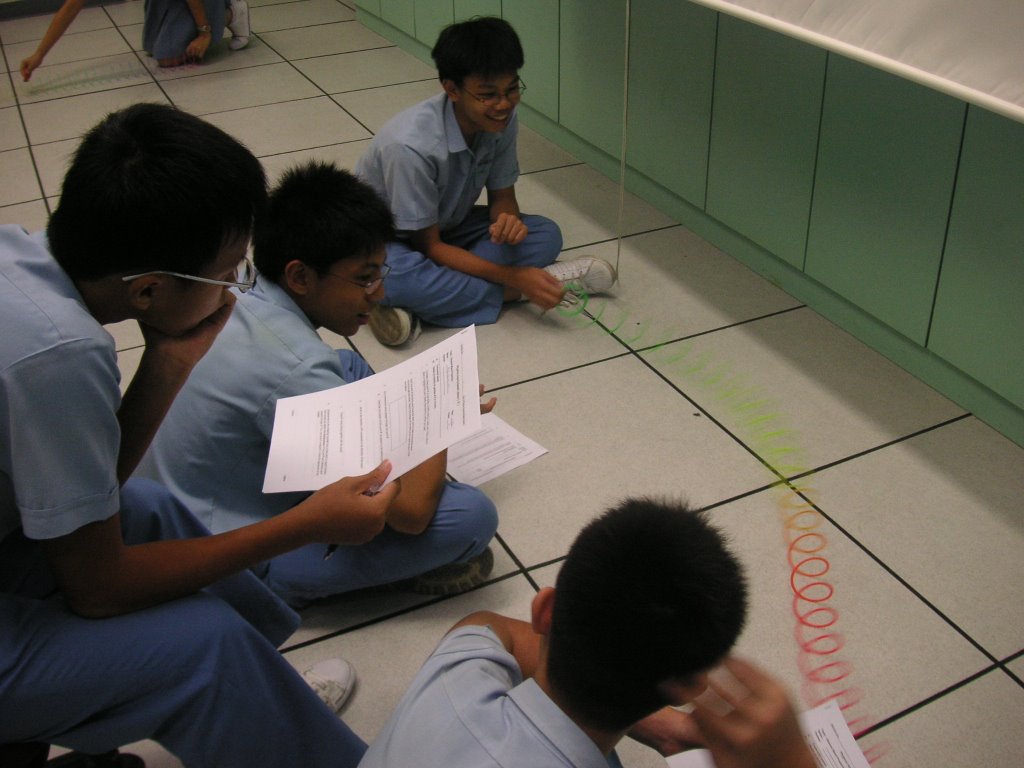
I conducted the 1st lesson on "General Wave Properties" with kind assistance from Elsie (ETD), Wan Eng and Peici in facilitating the students' activities. Some learning points:
1. Activity A1: group use of slinky to visualise transverse waves
- need close teacher supervision and facilitation
- some students prefer to have "fun" rather than focus on task given
- students are not used to describing observations of physical phenomena - in terms of language and vocabulary use
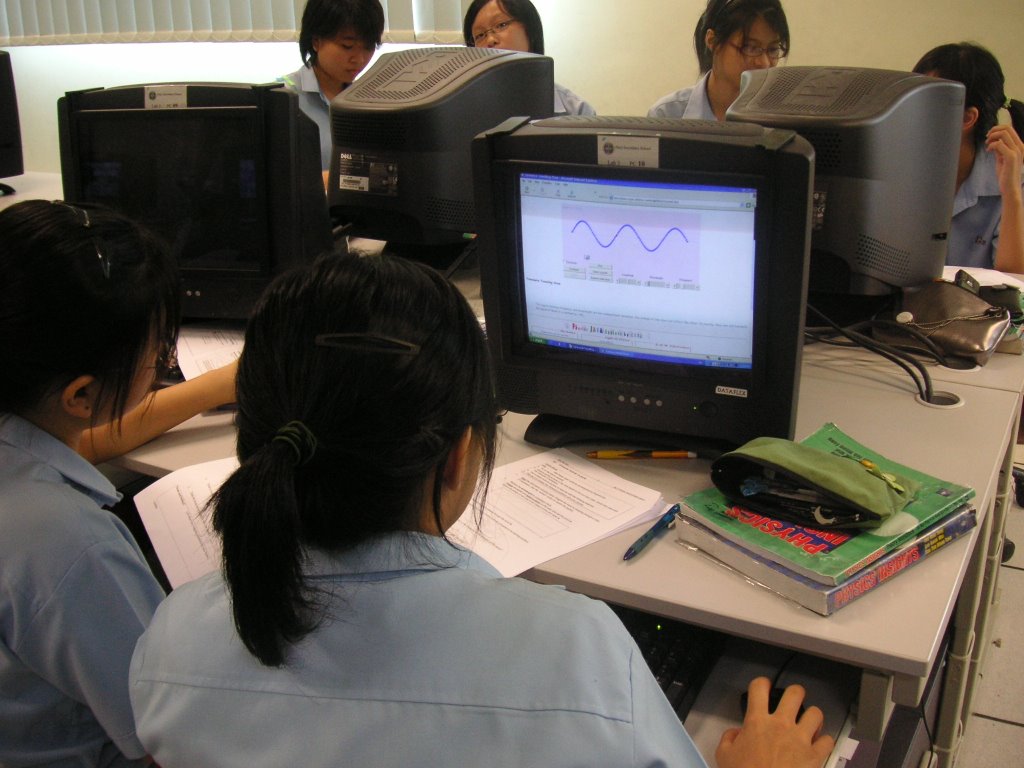 2. Activity A2: pair work on PC using applet via internet to investigate graphical representation for transverse waves
- close teacher supervision also required
- internet access may be slow on some PCs
- students have difficulty with concept of displacement (although concept was taught under "Kinematics") - prior discussion would be helpful.
- plotting a displacement-time graph also poses some difficulty - a guided approach to use numerical values to plot such a graph may be useful
- comparing the differences between displacement-time and displacement-position graphs may need more guided questions to bring out relevant features
- more capable students prefer individual PC work - they are more independent.
Monday, September 11, 2006
11 Sep 2006
Planning inquiry-based lesson on "General Wave Properties" with a focus on understanding of graph representation of transverse and longitudinal waves.
Tentative ideas:
Class: 308; Venue: Computer Lab 3;
Resources: slinky springs, web-based applets -
http://www.ngsir.netfirms.com/englishhtm/Lwave.htm
http://www.ngsir.netfirms.com/englishhtm/TwaveA.htm
- powerful simulations to help students visualise wave motion graphical & representation
Activities:
1. introduction to wave properties and terms
2. group work - handle slinky springs to create transverse & longitudinal waves
3. pair work - explore features of waves using web-based applets with guided inquiry-based worksheet.
Planning inquiry-based lesson on "General Wave Properties" with a focus on understanding of graph representation of transverse and longitudinal waves.
Tentative ideas:
Class: 308; Venue: Computer Lab 3;
Resources: slinky springs, web-based applets -
http://www.ngsir.netfirms.com/englishhtm/Lwave.htm
http://www.ngsir.netfirms.com/englishhtm/TwaveA.htm
- powerful simulations to help students visualise wave motion graphical & representation
Activities:
1. introduction to wave properties and terms
2. group work - handle slinky springs to create transverse & longitudinal waves
3. pair work - explore features of waves using web-based applets with guided inquiry-based worksheet.
Friday, September 08, 2006
Internet resources (2)
These are some sites featuring common physics preconceptions/misconceptions:
1. Recurring Science Misconceptions in K-6 Textbooks (William J. Beaty)
http://www.amasci.com/miscon/miscon4.html
2. Misconceptions spread by K-6 Textbooks on Electricity (William J. Beaty)
http://amasci.com/miscon/elect.html
3. Clarifications of certain Physics misconceptions or preconceptions using videoclips (Xinmin Online!)
http://www.xinminss.moe.edu.sg:1285/physics/misconceptions/physicsmisconceptions.htm
These are some sites featuring common physics preconceptions/misconceptions:
1. Recurring Science Misconceptions in K-6 Textbooks (William J. Beaty)
http://www.amasci.com/miscon/miscon4.html
2. Misconceptions spread by K-6 Textbooks on Electricity (William J. Beaty)
http://amasci.com/miscon/elect.html
3. Clarifications of certain Physics misconceptions or preconceptions using videoclips (Xinmin Online!)
http://www.xinminss.moe.edu.sg:1285/physics/misconceptions/physicsmisconceptions.htm
Subscribe to:
Posts (Atom)